Saturday, October 24, 2015

Writing a Mosaic


One of the great pleasures of my work, for which I never lose interest, is examining, listening to, and reading history shared by those who were there.  We call these primary sources.  They may be illustrations, photographs, witness testimony, letters and other correspondence, oral histories, memoirs, diaries, and the like.  Of course, they are the products of people, and human memory is fallable, biased, and sometimes completely incorrect, but none of that really matters when you start applying multiple primary sources over each other.  Layers of primary sources create mosaics of experience and emotion.

Back in late July, I spent an afternoon and evening listening to the personal experiences of radar veterans of the Second World War.  These were follow-up interviews.  I had the pleasure of joining the Ottawa-area radar veterans for lunch and a day of oral history interviews the previous summer.  I now have several hours of recordings from numerous veterans, which adds to the recordings that were made by the Secrets of Radar Museum between 2002 and 2008.  Time is of the essence for capturing the voices of the men and women who served in WW2.  The youngest among them are 88 years old, the majority in their 90s.  Their numbers are dwindling fast.

More than simply carrying out interviews, I found myself being handed numerous items to take back to the museum.  These included correspondence, self-published memoirs and accounts, books, CDs, and more.  These objects were given to me for the museum, for my research, for "the book".  What book?  "The book you're going to write."  So I brought it all back with me and I thought about the book they all expect me to write.

I have been approached in the past about writing Canada's radar history, there's even a publisher that has expressed interest.  I've never really thought seriously about it, though.  I felt I wasn't expert enough, or I lacked the time, or the will, or the interest.  The only book I ever wanted to write was my mother's family's experiences during the Occupation of the Netherlands, and I've never gotten very far with that.  The idea of writing a book about radar is daunting, particularly as I have only the barest understanding of radio, physics, or electronics.

Mmm, tastes like chicken...


So there I was, surrounded by material that these veterans gave to me for "the book".  I thought about their faces as they put their histories in my hands.  In their eyes was the certainty that I would do it.  There was trust that I would tell their stories with dignity and respect.  When I accepted the materials into my hands, I was unknowingly accepting the responsibility for their histories.

I've never written a book.  I have no idea how to go about it.  I have read a lot of books, and certainly plenty of history books dealing with World War Two.  A few of them are excellent reads.  Some of them are interesting.  Too many of them are dry, or inaccessible, even boring.  I want my attempt to do justice to the personalities of the veterans, to have the levity and approachability of comfortable conversation, even when talking about difficult subjects.  I honestly don't know if I can do it.  But this summer I decided I'd give it a try. 

I have started writing "the book".  My hope is that I can take all that has been put down before me, those works that have been published, those which have only been circulated amongst friends and family, the letters, the photographs, the maps, documents, and mementos, and most of all, the hours of oral history recordings, and turn them into something worth reading.  I have no timeline, I only hope I can create for them the mosaic of history, experience and emotion they long for and deserve.


Monday, June 29, 2015

Catching Up with Museums

I've been doing some contemplation about museums lately, inspired by the University of Leicester's Massively Open Online Course (called a 'MOOC' for short), Behind the Scenes at the 21st Century Museum offered via FutureLearn.  Okay, I'm always contemplating museums, but I'm doing more of it right now, primarily due to this course.

As many of you know, Leicester's museum studies programme is one of the oldest in the world, and probably the highest respected in English speaking countries.  Many of the most significant thinkers in museum studies are among its faculty and alumni.  It attracts a substantial number of museum professionals, working in the field, into its courses.  It's also my alma mater, and a pioneer in distance learning, so, since I am not in a position to be able to jump across the pond to do my PhD with them, this little MOOC is perfect for keeping me aprised of the latest goings-on in museum thinking.

Although it's really meant as an introductory course, many of the participants are museum professionals doing exactly what I'm doing, and as we are encouraged to share and discuss our thoughts at every possible opportunity, it feels very much like a conference.  Not the kind of conference where executive directors go and drink a lot and jaw in the lobby, but the kind where educated and experienced peers from across an industry share their case studies, offer lessons, bring learning tools, minds meet, and real professional development occurs.  That said, it also is an opportunity for museum pros to meet and gather thoughts and ideas from non-sector learners as the course is open to all, and there are plenty of folks participating who have no museum background whatsoever.  I can't speak for other MOOCs, but this course really feels like proper education, is thought-out, eye-opening, and meaningful. 

This course is particularly interesting to me, not just because I get to think about museums in a semi-structured environment, but because my museum, the Secrets of Radar, is currently re-examining its exhibits and looking at ways to reorganise them for a greater impact and more positive experience.  SoRM is an amazing gem of a museum, and it's absolutely brimming with information and cool, weird 'stuff', but it's not really what I would consider a super fun or engaging space.  Its displays have been geared to people with a basic knowledge of radio and electronics, and it struggles to be welcoming for families with younger children.  I love the depth of information, but it isn't intellectually accessible.  Nor is it emotionally accessible.  When it was founded, the philosophy behind the original didactic panels was to get the unknown, secret history of Canadian World War II radar veterans out, to tell as much of the story as possible in a limited space.  This was absolutely the priority of the veterans who created the museum.  Now, it's time to refresh the exhibits through which those veterans no longer lead tours, no longer sharing their personal anecdotes.  It falls to me and volunteers to put the human aspect into the museum, which is a second-hand experience due to the passing of those founding vets.  It's challenging, but the MOOC is helping me think about how to reinvent SoRM without messing with its original purpose, while creating an open, engaging, accessible centre for history and learning.

When the course is finished, I'm sure I'll have more to share.

Monday, June 22, 2015

CAHS Convention Photo Round-up

In my last post, I talked briefly about the pleasure of presenting at the Canadian Aviation Historical Society annual convention and let me follow-up by saying the whole event was terrific.  Aviators, historians, retired (and serving) Air Force personnel, museum staff, and aircraft restorers all came together to learn about this country's incredible aviation history.  Canada has had an enormous impact on the global aviation sector from its infancy right through the 20th century.  I can't possibly talk about everything I learned or the people I met, but I can share some photos.  I also had the most incredible experience of spending two hours with a 99-year-old radar veteran living in Hamilton, ON.  If only I'd remembered my tape recorder.

I had a behind-the-scenes tour of the Canadian Warplane Heritage Museum's Bolingbroke restoration project.  That poster is a one-of-a-kind original.

I finally had an opportunity to tour "Vera" the CWHM's Mynarski Memorial Lancaster, which was built by A.V. Roe at Toronto's Victory Aircraft Ltd. site in Malton.  This was definitely a highlight.

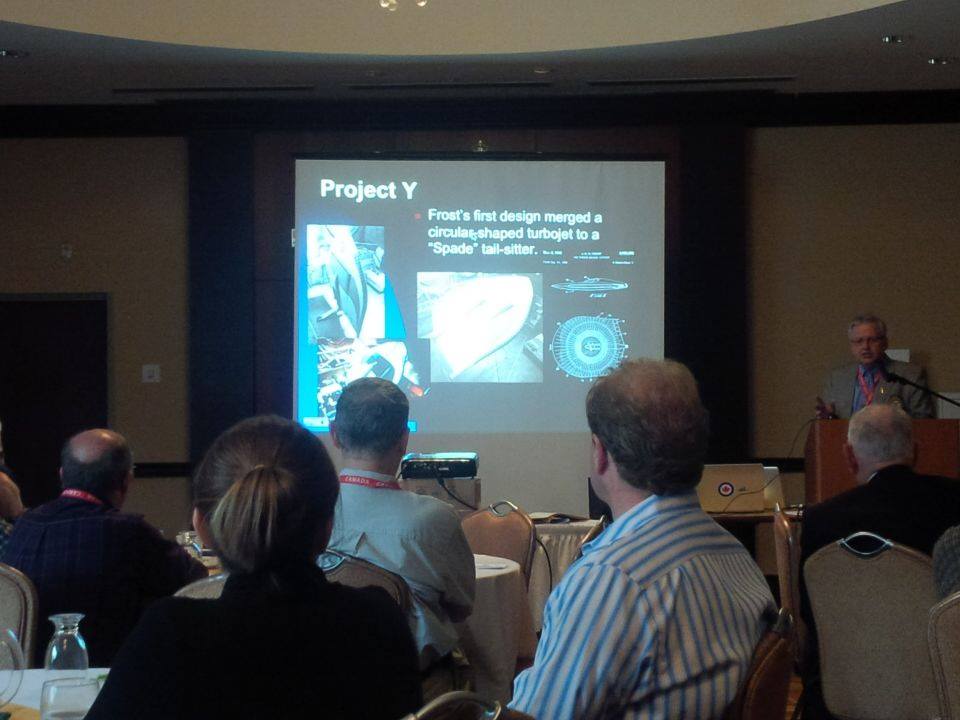
A fascinating presentation on the secret projects carried out by Avro in the 1950s, not just the "Arrow".

"Vera" in the hangar at the CWH Museum.

A presentation about Vi Milstead, who led a very interesting career in aviation at a time when few women were flying.

Sunday, June 21, 2015

Canadian Aviation Historical Society Convention

I had the great privilege to present about my beloved museum today (June 18, 2015) at the CAHS annual convention, which is being held in Hamilton, Ontario.  I've never attended one of their conferences before, and, so far, I'm thoroughly loving it.  I'm not an aviator, nor do I have an aeronautical background, but the joy of the CAHS is that it makes aviation history accessible to all.  Presenting at the conference was a pleasure, although I was quite nervous that everyone would know more about radar than me.  I decided not to focus on the technical aspects of radar or the technical advances through WWII, but to talk about the work the museum does, and to share some of my favourite stories as originally told to me by veterans at the museum.  That's what I love most about my job, the ability to share true stories and make connections between the past and the present through personal anecdotes and memories.  I'm looking forward to the rest of this conference, although I probably won't get a chance to post this, or any further entries until I return home in a few days.

Membership in the CAHS is worth it, just for this amazing journal.  Seriously.


Saturday, May 16, 2015

Some Nifty Canadian Museums

Buzzfeed has a list of 39 museums to visit before you die. Unlike many BF lists, this one is pretty well rounded. I would go so far as to say it's a good list. Sure, it skews heavily to America with a nod to Europe and, I think, one Canadian entry (the Canadian War Museum, which really is an incredible experience and you should totally visit), but you don't see much from Asia or pretty much the entirety of the Southern Hemisphere. Considering that the Buzzfeed community, while global, is largely centred in the English speaking West, it's not surprising. And, frankly, I can't add much more to the list because I am not well travelled, not in a global sense.

But, I am well travelled enough through Canada to add a few more selections. Not necessarily suggested for their big budgets or blockbuster exhibits, here are five museums, in no particular order, you should totally visit in this diverse and gigantic country I call home.

Manitoba Museum, Winnipeg: it has a sailing ship inside it. They built the wing that houses The Nonsuch around the 17th century naval ketch. It also houses the spectacular HBC gallery, which showcases some of the incredible artefacts collected by the Hudson's Bay Company over three hundred years.  Also, it's the home of the world's largest trilobite.

Canadian Museum of Immigration at Pier 21, Halifax: Canada's version of Ellis Island and no less emotionally charged, this museum of immigration focuses heavily on the lived experience, using oral history effectively within simple, but aesthetic exhibits.

MacBride Museum of Yukon History, Whitehorse: There are a number of wonderful, unique museums in Yukon, and I had some trouble deciding to pick this one over the others.  That said, this museum has a pretty diverse collection and touches on natural and cultural history in a place where nature and culture are intimately entwined.

The Canoe Museum, Peterborough: It's not just a museum about canoes.  This is a museum about Canada.  It encompasses First Nations histrories, colonial and settler histories, art & craft, mechanisation, industry, tourism... I could go on.  Also, it's just plain nifty.

Buxton Museum National Historic Site, North Buxton (Chatham): This little museum in southwestern Ontario blows my mind.  The story of Buxton is one of the Slave Trade and the Underground Railroad as much as it is of success and struggles, percerverance, and community.  While you're in the area, you can also visit the real Uncle Tom's Cabin and just driving through the region you can also find plenty of colonial and 1812 history, too.  It's not all corn and tobacco fields.

Have you visited any of these sites?  What did you think of them?  Leave a comment.


Wednesday, May 13, 2015

Thinking About Education in (or out of) Museums

Let me be very clear: I do not consider myself a museum educator.  That said, what I do have is many years worth of experience leading, developing, and evaluating museum education programs. I also have a degree in museum interpretation, which is certainly related to learning in museums, though not strictly curriculum based.  I consider myself to be a museum curator with an excellent grasp on the many facets that interlink to create great, engaging museum content.

There are lots of different types of museum education programs out there.  Some are rigidly scripted, others are more free-form.  I've had experience delivering both and the spectrum in between.  There are multiple ways to teach in a museum setting, just as there are multiple kinds of learning styles.  Some work better than others, depending on the subject, age-level, or venue.  The point of this post is not to judge.

Recently, I've had occasion to think about museum education as I have been developing brand new outreach programming for the Secrets of Radar Museum.  At one time, the Museum actively courted school groups as visitors, participating in local programs to drive in attendance.  I think it's safe to say that, as a niche museum, somewhat off the beaten path, it was never overwhelmed by the response from regional schools.  Having great education programs alone will not bring in the buses.  In fact, the buses are one of the biggest obstacles to bringing classes to the Museum.  As a small venue, it is logistically challenging to host more than one full-size class at a time.  Busing is an expense, and schools naturally want to get their money's worth by making sure field trip buses are filled to capacity.  This can mean 50-60 children, or the equivalent of two large classes.

In order to successfully combat the busing challenge, the Museum Board President, Katrina Urban, herself an accomplished museum educator (for real, and whom you should totally check out online), suggested creating Outreach programming for 'Radar' to bring into the classroom.  She's had success developing and delivering outreach programming.  Outreach is already central to the Museum's public engagement policy, in that we regularly attend and participate in off-site events through presentations, activities, and displays.  Why not in education programming?

Together, Katrina and I decided to focus our initial programming push at two grade levels: grade 6 for an introduction to the mechanics of flight, and grade 10 for a focus on local experience in WW2 and Cold War.  Both dovetail with the Museum's narrative, with radar being a tool developed initially to locate aerial objects, and the Museum's mandate to share the personal experiences of Canadian radar personnel.  Katrina laid out the program model which she found most successful, incorporating a visuals-heavy presentation, hands-on artefact handling, and small group-based exploratory assignments.  There are multiple opportunities to discuss and demonstrate, both for the educator and the students. Although the subjects are different for the two outreach programs, the model doesn't change.

Here's the thing about the model we're using: we get that students don't all learn in the same way.  We're not cookie-cutter identical at any age, really, but I digress.  This model allows students who prefer or benefit from passive receipt of information to do so, as well as those who need to learn through active participation, both non-judgementally.  There is also an opportunity for students to work independently and to lead and teach each other, which can be very beneficial for those with social anxieties or problems with authority figures.  Using image-heavy presentations is helpful for visual learners for whom pictures are another layer of language, or for those with dyslexia or similar learning challenges.  In this model, every child is able to take something away, regardless of how they learn.

The Museum used a grant from the Agape Foundation of London, Ontario to pay for the development of the new programs and materials, and to provide an honorarium to the educators that lead the outreach.  Material was distributed through the school boards and posted on the website and, so far, in the program's first month, we've fielded a lot of interest, at least at the grade 6 level, and delivered two programs.  My feeling is that at the high school level, the programming will be a hot commodity coming up around Remembrance Day.

I have naturally spent a lot more time with the Ontario Curriculum than I have in a long while, and I've dipped into a number of museum education support materials that have languished on my shelf since completing my MA.  While I have never forgotten the intrinsic part education plays in museums, I had begun to look at it in an abstracted, theoretical way, which doesn't actually help me deliver programs to anyone.  While there are roles in the museum world that need no exposure to public or education programming, I firmly believe that museum professionals who prepare content for exhibitions and publication should have some understanding of, if not direct experience in, museum education.  Even if it means a curator shadows a school tour to observe how students interact, or does a rotation on an outreach event during March Break or a Camp, it's incredibly beneficial to remember that engaged children grow up to be engaged adults and engaged adults become museum supporters.


Friday, April 10, 2015

#Curating - it's trending and trendy

CURATOR:  (ky-rtr, kyr-tr) n.
One who manages or oversees, as the administrative director of a museum collection or a library.
[Middle English curatour, legal guardian, from Old French curateur, from Latin crtor, overseer, from crtus, past participle of crre, to take care of.]

Due in part to the Curatorial Ethics conference taking place (*gasp* without me!) in Vienna, "curating" is trending right now.  Just yesterday, I was talking with my friend who is the curator of Banting House National Historic Site, about just how much we dislike "curate" and "curator" as buzzwords.  The discussion stemmed from one of my tweets:
Imagine my surprise today when I saw that very subject trending.  I told my friend at Banting House that I might just have to blog about how much the over-use of "curator" irks me.  So here we are.

I'm not sure when the word made the jump into the popular vernacular, but someone latched on and it took off.  It's been gaining popularity over the last few years.  And I hate it. 

I love the idea that people want to be curators, except that most people using the word to describe their audio playlists have absolutely no idea what curation is actually about.  There is this conference going on right now, and they're talking abut big issues in curatorial practice, like ethics, the commercial art market, and politics. Yes, it is terrific you want to take ownership of your expression, and perhaps you're putting a fair bit of thought into it, but there's a whole lot more to curating than an aesthetic or organised display of stuff.  Here's what the Curatorial Ethics conference introductory text says:

The verb ‘curate’ derives from the Latin curare and means to attend to something and thus also to take responsibility – for an exhibition, for the participating artists, for the works etc. In the business world the code of ethics, which defines what is legitimate and what is not, is becoming ever more important. In the curatorial field too, important parameters have been shifting in recent years. We have seen subtle but lasting changes in the relationship between public and private collections, together with the handling of the latter, in the relationship between the institutional art establishment and the art market, and finally in the relationship between curators and artists.

So the time is ripe to talk about a curatorial code of ethics: where are the boundaries, what are the grey areas? The point of departure for this three-day conference, in which international representatives of various sectors of the art world will present their viewpoints, is not so much to discuss deficiencies and problems, but instead to fundamentally acknowledge that these exist.


Being a curator is a practice of intention and responsibility.  Although the role can vary widely depending on whether it is done in an art gallery or museum, whether it's a large or small organisation, public or private, there are certain key aspects that are integral to curatorial practice.  A curator is a keeper or steward of a museum or other collection.  They are responsible for advice on new acquisitions for the collections, the administration of the collections, as well as their documentation, research, and exhibition. 

Professional curators are frequently experts in their field or subject matter.  Very often they have devoted years to reasearching their areas.  Many curators publish their research in academic journals, write texts and articles, present at conferences and symposia.  Not all curators have PhDs, but many of them have devoted enough effort and scholarship to rival the equivalent of  numerous higher degrees.  Curators spend a lot of time considering the selection and placement of objects in their exhibitions and publications to create and enhance narratives, to create dialogues between works of art, to share ideas, to (in)validate arguements.  All the while, curators are expected to work within the ethical parameters of their fields, work within often very strict budgets, share their knowledge, mentor students, and always remain responsible for their collections.  Concerns of marketing, SEO tools, and superficial categories or tags do not enter the minds of most proefessional curators when they're in the midst of curatorial practice. 

Curators are, with few exceptions, committed, dedicated, thoughtful, educated, and trained professionals.  So, next time you talk about curating your iTunes library, or your website, your brand affiliations, Instagram, or whatever else, please consider that curators do a whole lot more than simply hanging pictures, making things look or sound pleasing, and mincing about in white gloves, elbow patches and horn-rimmed glasses. 

What are your thoughts?  Do you agree or disagree with me?  Don't be afraid to weigh in.